
Watch on Youtube…
Few topics stir as much tension in biblical study as the question of hell’s final outcome. Is hell a place of unending conscious torment, or does Scripture point instead to final destruction—annihilation—for the wicked? Both views claim biblical support. Both appeal to God’s justice. And both draw from images and language woven through the Old and New Testaments.
This study aims to cut through tradition and emotion by returning to Scripture itself. What does the Bible actually say? What language does it use? And how did early believers understand the final destiny of the lost?
1. The Traditional View: Eternal Conscious Torment (ECT)
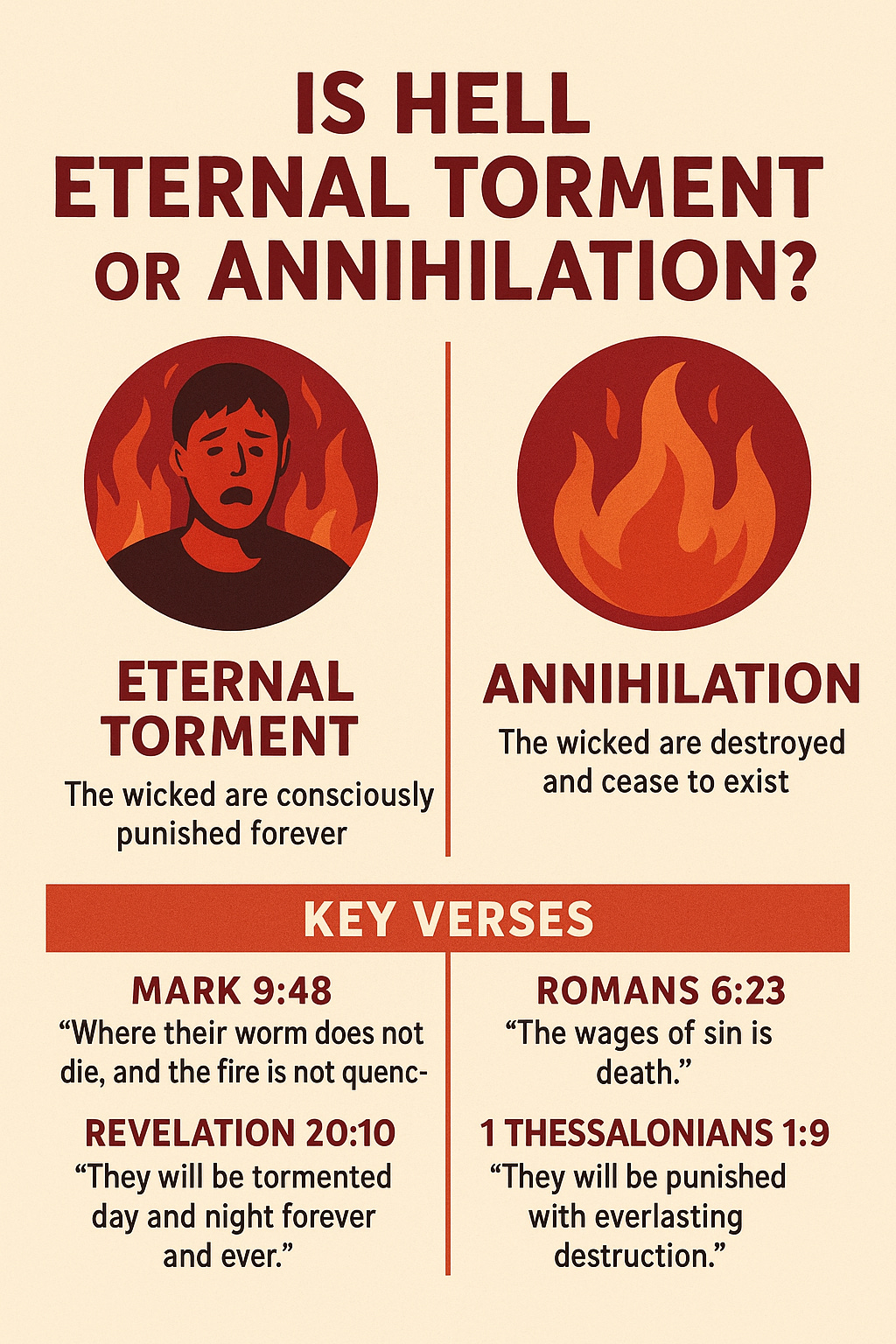
The historic church position, especially since Augustine, teaches that the lost remain forever conscious, experiencing ongoing judgment. The key word is eternal, not merely in consequence but in duration.
Biblical Support Often Cited
1. Eternal Fire & Unquenchable Flame
Jesus uses striking language when He warns,
“Where their worm does not die, and the fire is not quenched.”
— Mark 9:48
Fire that never goes out suggests ongoing punishment.
2. The Smoke Rising Forever
John’s Revelation offers another vivid picture:
“The smoke of their torment goes up forever and ever.”
— Revelation 14:11
The imagery resembles the ruins of Sodom—a city God destroyed so thoroughly that smoke symbolized its lasting testimony.
3. The Devil’s Fate Used as Comparison
Revelation also states:
“They will be tormented day and night forever and ever.”
— Revelation 20:10
While this is specifically about the devil, beast, and false prophet, supporters of eternal torment argue the wicked share a similar destiny (20:15).
The Justice-Based Argument
If God is infinitely holy, sin is infinitely offensive. Therefore punishment that reflects God’s nature must also bear eternal weight.
2. The Conditionalist View: Final Destruction (Annihilation)
Conditional immortality—often called annihilationism—teaches that the wicked are destroyed, not preserved forever. Only the redeemed receive immortality as a gift.
Key Scriptures That Support This View
1. “The Wages of Sin Is Death” (Not Endless Life in Torment)
Paul writes plainly:
“The wages of sin is death, but the gift of God is eternal life.”
— Romans 6:23
Death is the opposite of life. Conditionalists argue the lost do not receive eternal conscious existence—only eternal consequences.
2. “Destruction” Means… Destruction
Jesus warns:
“Wide is the gate that leads to destruction.”
— Matthew 7:13
Similarly Paul says:
“They will be punished with everlasting destruction.”
— 2 Thessalonians 1:9
“Everlasting destruction” is read as a permanent result, not an ongoing process.
3. Fire Consumes—It Doesn’t Preserve
John the Baptist declared:
“He will burn the chaff with unquenchable fire.”
— Matthew 3:12
An unquenchable fire keeps burning until everything is reduced to ash. It is unstoppable, not endlessly torturous.
4. Only God Is Immortal
Paul states:
“He alone has immortality.”
— 1 Timothy 6:16
Immortality is not inherent in human souls but granted through Christ (1 Cor. 15:53). Therefore, conditionalists argue the wicked cannot be eternally alive unless God sustains them.
Justice Argument
A loving God does not inflict eternal suffering but brings an end to sin, rebellion, and the existence of evil entirely.
For them, annihilation is just, permanent, and aligned with God’s character.

3. What Did Jesus Emphasize?
Jesus spoke more about judgment than anyone else in Scripture. Yet His imagery varies:
Some illustrations depict ongoing consequences (e.g., the worm that does not die).
Others depict final death (e.g., destroyed in Gehenna—Matthew 10:28).
Others portray banishment (e.g., outer darkness, weeping and gnashing of teeth).
This variety suggests Jesus wasn’t giving a single mechanical description of hell, but revealing the severity of rejecting God.
A Key Verse Often Overlooked
“Fear Him who can destroy both soul and body in hell.”
— Matthew 10:28
The word destroy (Greek: apollymi) rarely means torment. It consistently refers to death, ruin, elimination, or perishing.
This verse alone is one of the strongest cases for annihilation.
4. What Did Early Christians Believe?
The early church was not unanimous:
Eternal torment was taught by Tertullian and later Augustine.
Annihilation was taught by Arnobius and others.
Universal reconciliation (a small minority view) was taught by Origen.
This shows the debate isn’t modern.
5. So Which View Is Right?
Simple Recap & Final Thoughts
Eternal conscious punishment comes directly from Jesus’ teaching. In Matthew 25:46, He places the destiny of the righteous and the wicked side by side:
“And these will go away into everlasting punishment, but the righteous into eternal life.” — Matthew 25:46
The same Greek word for eternal (aiōnios) describes both destinies. If eternal life is unending, then—according to Jesus—so is eternal punishment. This parallel is one of the strongest scriptural anchors used to support the view that hell’s consequences are not temporary or finite.
This verse in Revelation lets us know that Hell is not the final place for those who die without Christ but it is an Intermediate state until the Final “Great White Throne Judgement in Revelation”
“Then Death and Hades were cast into the lake of fire. This is the second death.” — Revelation 20:1
Hell is often viewed as a temporary holding place for the dead before a final judgment, while the Lake of Fire is the permanent, eternal destination for those who have been judged and found without a place in the book of life. The Lake of Fire is described as the “second death” from which there is no resurrection, and into which hell (Hades) itself will eventually be cast.
Hell
Temporary holding place:
In many biblical interpretations, “hell” (also referred to as Hades or Sheol) is a temporary state or location for the spirits of the unsaved after death.
Undergoes judgment:
At the final judgment, Hades and Death are said to give up their dead, who are then judged.
Lake of Fire
Final destination:
The Lake of Fire is the ultimate, eternal punishment for the wicked, the devil, and his followers.
Permanent judgment:
It is referred to as the “second death,” a state of complete and final separation from God.
Includes hell:
According to Revelation, hell itself (Hades) is cast into the Lake of Fire, indicating it is a greater and more final place of judgment.
“Then Death and Hades were cast into the lake of fire. This is the second death.” — Revelation 20:1
If Hell is eternal punishment & the Lake of fire is eternal punishment… and Eternity for the righteous with be the same
It is safe to say that while in Hell and In the lake of fire those who have died without Christ will suffer eternally and will not be annihilated.
5 Questions & Answers
1. If God Is Loving, Why Would He Allow Eternal Torment?
Answer:
God’s love does not negate His justice. In Scripture, judgment is the necessary response of a holy God toward unrepentant sin. Eternal punishment exists not because God delights in torment, but because:
Sin against an infinitely holy God carries eternal consequences.
People choose separation from God by rejecting His grace.
God honors human freedom—even when that freedom chooses darkness.
Key verses:
“These will go away into eternal punishment, but the righteous into eternal life.” — Matthew 25:46
“God is just.” — 2 Thessalonians 1:6
God’s love is shown in that Jesus took the full wrath of God to save us from this fate (John 3:16–18).
2. Why Is the Torment Described as “Forever and Ever”? Can It Really Mean Eternal?
Answer:
Yes. In Greek, the phrase “eis tous aiōnas tōn aiōnōn” literally means “unto the ages of the ages,” the strongest possible expression for unending duration.
This exact phrase is also used to describe:
God’s eternal nature
Christ’s eternal reign
Eternal life for believers
If “eternal life” is endless, then “eternal punishment” uses the same language and must also be endless.
Key verses:
Revelation 20:10 — “tormented day and night forever and ever.”
Revelation 14:11 — “the smoke of their torment rises forever and ever.”
Matthew 25:46 — same word for “eternal life” and “eternal punishment.”
Scripture places the eternal destinies of the righteous and wicked side-by-side using identical language.
3. Why Isn’t Hell Just a Temporary Punishment or a Second Chance?
Answer:
Because the final judgment is final. After death, there is no biblical indication of repentance or a “post-mortem salvation opportunity.”
Jesus taught:
The door is shut (Matthew 25:10)
The gulf is fixed (Luke 16:26)
Judgment follows death (Hebrews 9:27)
The Lake of Fire is final, irreversible, and eternal.
Moreover, the wicked in Revelation do not repent even under judgment. The heart grows harder, not softer (Revelation 16:9,11).
4. Why Are Death and Hades Thrown Into the Lake of Fire? What Does That Mean?
Answer:
Death and Hades (hell in the temporary sense) are not persons but powers or realms.
They are destroyed because:
Death is the enemy Christ came to defeat (1 Cor. 15:26).
Hades is the temporary holding place of the dead — unnecessary after resurrection.
Throwing Death and Hades into the Lake of Fire represents:
the end of death’s power,
the end of the grave,
the completion of God’s victory, and
the beginning of eternity.
Once this happens, only fixed eternal states remain:
Eternal life
Eternal judgment
There is no more intermediate place, no more cycle of death.
5. How Do We Know the “Second Death” Isn’t Just Annihilation?
Answer:
Because Scripture repeatedly uses language describing ongoing existence in ongoing judgment, not cessation.
Evidence for conscious, ongoing experience:
Revelation 20:10 — “tormented day and night forever and ever.”
Revelation 14:11 — “no rest day or night.”
Luke 16:23–24 — conscious torment before final judgment.
Matthew 25:41 — “eternal fire prepared for the devil.”
Matthew 25:46 — eternal life vs. eternal punishment (same duration).
Additionally:
If the wicked ceased to exist, there would be no torment, no “weeping and gnashing of teeth,” no “shame and everlasting contempt” (Daniel 12:2).
The devil is not annihilated; he is tormented forever. The wicked join him in the same fate (Revelation 20:15).
Thus, the “second death” is not extinction —
it is eternal separation, eternal regret, and eternal divine justice.
Additional Evidence for Eternal Punishment + Study guide


